Jack Campin's homepage

- My Twitter page
(id: JackCampin), for up-to-date information about local
open sessions for the kinds of music I play (let me know if
there's something I should announce here).
Forum
discussion about this, on Mudcat.
- Former CD-ROM projects, now free downloads:
- Traditional music resources: the tunes are all in ABC format.
See the ABC home page
http://abcnotation.com/ for
a specification of this notation, software (mostly free or cheap) for
processing it and links to archives of music transcribed in it. The
rationale for my tune collections is:
- not to duplicate what anybody else is doing
- to do it right the first time
The tunes are mostly taken from old and rare sources most people don't
have access to, and edited as carefully as possible. ABC is very compact;
none of these files are big. If you don't want to install anything on
your computer, there are web-based converters at these sites:
For all of them, you just paste some ABC into a box and
it'll give you both staff notation and a playable MIDI file.
(When using your browser as an ABC application in this way, set
it to display the ABC with a fixed width font like Courier).
Another tool that may be useful in conjunction with these is
Jens Wollschlager's ABC transposer.
- An illustrated tutorial on modes and
tonality in Scottish music with hundreds of tune examples, aimed
at performers rather than musicologists. I update this continuously
with new ideas and example tunes.
- Tunes from the repertoire of
Edinbal, Edinburgh's
"bal folk" group for modern European folkdance. They are
in both ABC and
PDF formats.
- Finnish tunes: this is a
cleaned-up version of an ABC file originally uploaded by Dick
Atlee. 36-page PDF file
generated from it.
- The Nine-Note Tunebook, over 600
tunes for narrow-range instruments nine notes up from middle C, mainly
on the white notes but with a few accidentals. They come from many
different cultures and genres.
- Klezmer tunes
as played by the Edinburgh Klezmer session, which meets upstairs at the
Fiddler's Elbow, Picardy Place, every second Thursday between 7.30pm and
9.30pm. I am also putting these tunes on a blog, converted to staff
notation and MIDI:
http://edinburghklezmertunes.blogspot.com .
The ABC file will always be more up to date.
- A collection of 40 Scottish
session tunes, intended as a resource for musicians visiting
Scotland who already play an instrument but are new to Scottish music.
Start any of these a in pub session and somebody will join in with you.
- A musical note reference using
QuickTime and MIDI files, mainly intended for use by non-musicians
selling instruments over the web so you can say what key they're in.
- All the tunes (both songs and Northumbrian pipe tunes) from Bruce and
Stokoe's Northumbrian Minstrelsy
of 1882.
- Andrew Blaikie's ballad tune manuscript
of the early 19th century, 134 tunes with Blaikie's own simple and
tasteful bass lines (this uses BarFly syntax for multivoice ABC).
- David Young's dance manuscript of 1740
in the Bodleian Library. This has the most fashionable dances of that
year in Edinburgh, with tunes and detailed dance instructions. (Young
was responsible for some of the most important collections of his time,
particularly the vast Macfarlan MS). I've tried to notate Young's amazing
calligraphy in ASCII.
- G.S. McLennan tunes; a carefully
edited collection of all the tunes Pipe Major G.S. McLennan
published in his lifetime, a few others, and a bibliography of his
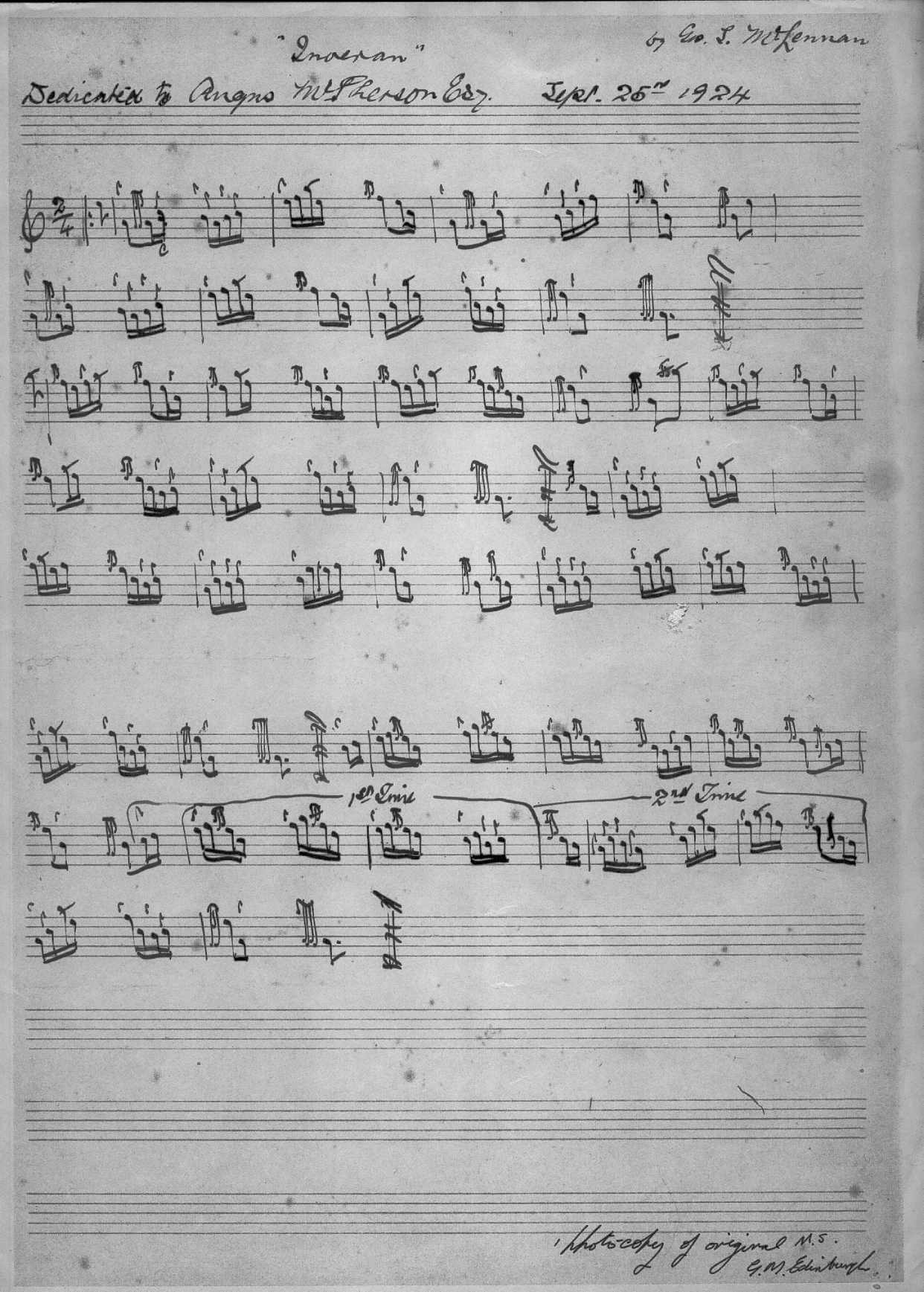
work. I also have a scan of the manuscript copy of McLennan's
march Inveran that he wrote out
for its dedicatee Angus MacPherson; thanks to Angus's grandson
George for this.
- Materials (pictures, ABC music, perhaps sound files later) on the
Edinburgh moothie player Iain Grant
(under construction).
- The music from Joseph Mitchell's ballad opera of 1731,
The Highland Fair.
This is a little-known and never-reprinted work, the earliest
or one of the earliest sources of many Scots tunes, in simple
and folk-like versions.
- YoupNannette, a collection of 29
bourrees from Berry in central France.
Version for G/D instruments, with
a range from an octave to a twelfth up from D;
PDF of that G/D version.
- A collection of tunes with filthy titles,
mostly from 18th century Scotland.
- Five tunes with Halloween associations.
- The bagpipe tunes from George Skene's
manuscript of 1715, the oldest written Scottish pipe music.
- American colonial and US Civil War
music for the fife, tidied up from a file I found on a site
that no longer exists. If the original transcriber ever finds me,
please get in touch.
- A few American tunes published in
Edinburgh by John Clarkson around 1805, for the piano.
- 16 Highland dance tunes from an early
19th century collection by Alexander McKay. This is contemporary
with Simon Fraser's better-known collection of Highland music, but
the settings are much simpler and far more believable as a record
of the way Highlanders might have played it at the time.
- Tunes from Measan Milis as an Lios,
(The Sweet Lapdog of Lismore), Gaelic songs by Captain Eoghan
Anderson (d. 22/8/1909), published in Glasgow in 1925.
- 18th century Scots music for the
guitar.
- Tunes said to have originated with the fairies in Shetland.
- Tunes relating to the Battle of Flodden, 9 September 1513.
- Some Dutch tunes: ten branles from
the seventeenth century collection't Uitnement Kabinet
transcribed from GIF scores on a website devoted to the Utrecht
recorder-player/composer/bellringer Jacob van Eyck (and thereby
making them about 100 times smaller to download).
- ABC transcriptions of four tunes to be
used at the World's Biggest Ceilidh Band record attempt in memory of
Malcolm Douglas, 18 October 2009, in Sheffield.
- A page on the Lament for the Bishop
of Argyll, from the Macfarlan Manuscript of 1740.
- The Piper of Peebles, a
précis of a Scots broadside of 1793.
- A mediaeval ballad on the murder of
Thomas Becket.
- A list of regular folk-related
events in Midlothian.
- A set of pages about musical instruments that so far are hard
to find out about from paper or WWW sources.
- The Italian ocarina. (Very much
enlarged, October 2011). I also have a blog,
OcTunes, where I post
music suitable for Italian ocarinas. This has many inlined
images; the only page on this site that really needs broadband.
Traduzione in Italiano
a cura di Elisa Mazzariol (PDF, 2.7Mb).
- The cümbüş
(Turkish fretless steel-strung lute-banjo).
- The Romanian cobza (small fretless lute).
- What seems to be a recorder with drones
from Athanasius Kircher's Musurgia Universalis of 1650.
- The Till Family Rock Band, a late
19th century English/American group who gave thousands of concerts
on the lithophone.
- The Dalmatian bagpipe
(just pictures).
- The sipsi, the small Turkish folk clarinet
(just pictures).
- The Mouth Flutina, a 19th century
relative of the melodica.
- The zaqq, the Maltese bagpipe.
- Early music stuff:
- A JPEG scan of Brewer's New
Instructions for the Clarinet, an early 19th century English
tutor for the five-key clarinet with English, Scottish and Irish
folk and popular tunes to play on it. 33 files, averaging a bit
under 50K each.
- An ABC version of the fifty three-part vocal fugues from Michael
Maier's Atalanta Fugiens of
1617-18, a musical commentary on the alchemical process. Revised
version 1.3, August 2005.
- Political stuff: a collection of documents you won't find elsewhere
on the Web. I now have a scanner with OCR, so this is likely to expand
rapidly in the near future - keep checking.
- Pictures:
- Picture of me from the mid-1990s by Graeme
Craig-Smith [1966-2002].
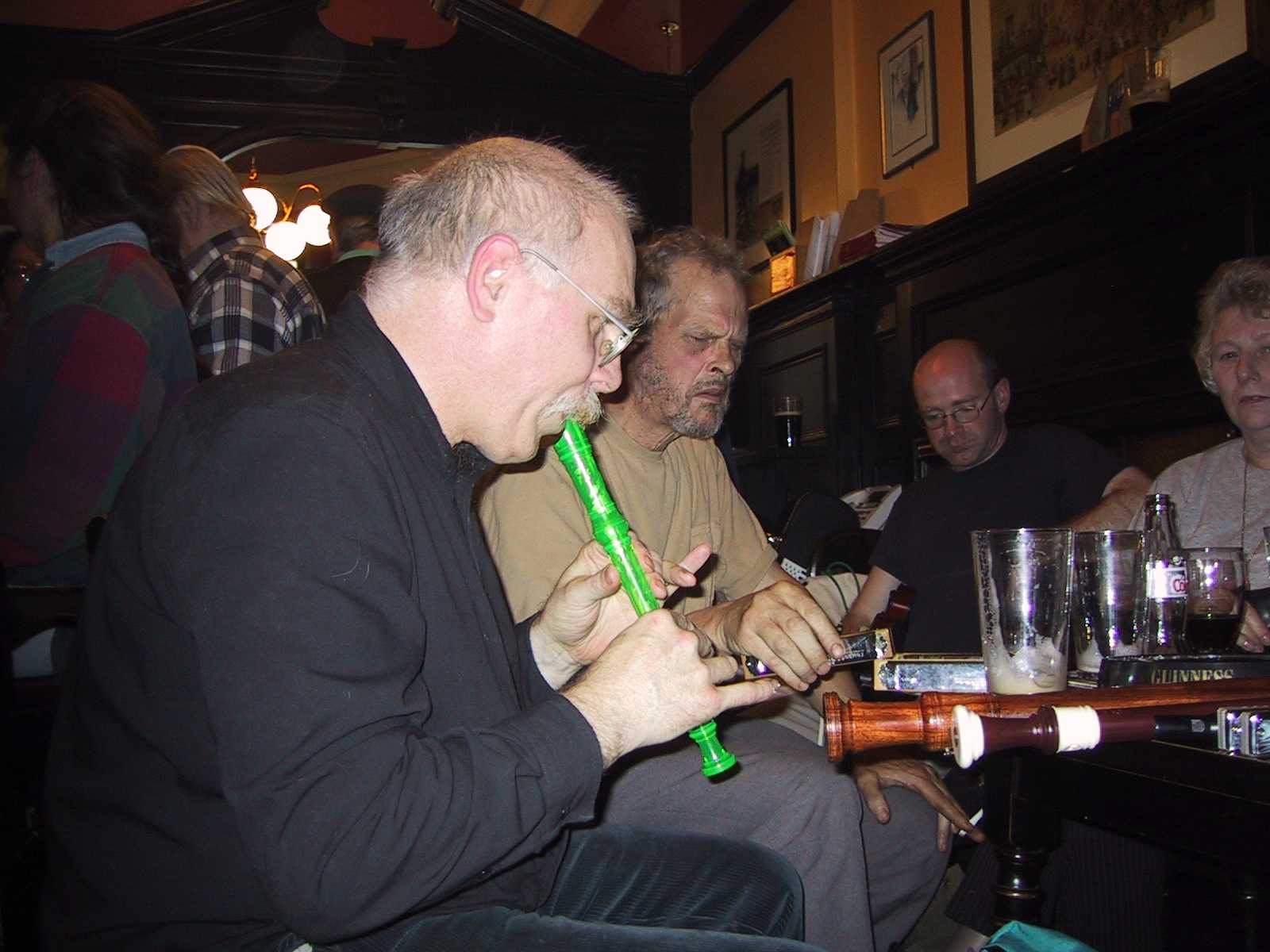
- Another picture of me
taken on a digital camera in 2000 by Havard Rokke, at the Sandy Bell's
session on a Sunday afternoon. I'm playing "The March Hare", which
modulates from A minor to D minor, and the perplexed expression of the
harmonica player (Eddie Wallace from Glasgow) is because he's wondering
what on earth is the appropriate moothie to use for it.
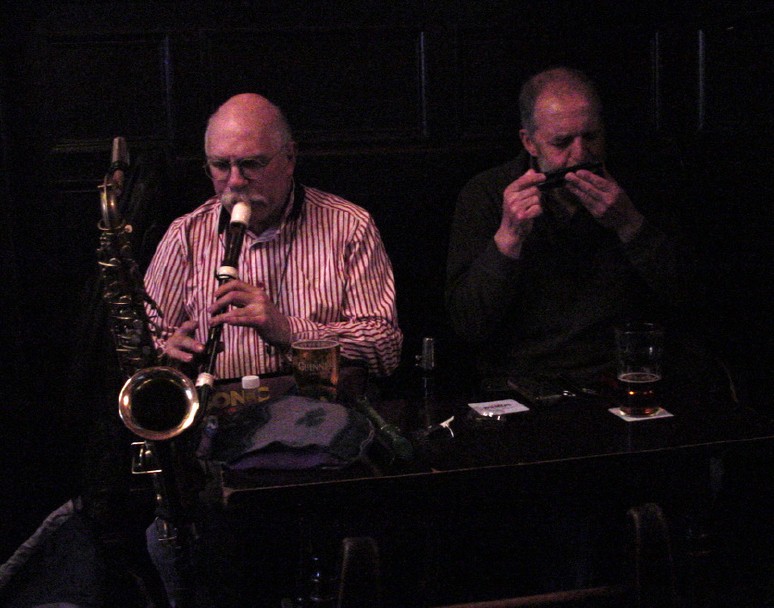
- Me and George Current
at the Bells Sunday session, in 2008 (photo by Sean from Derry). I'm
playing a Lee-Collins-modified Zen-On Bressan treble recorder; the
sax is a 1922 Buescher C melody. George is probably playing a Hohner
diatonic moothie in C. George has a website on the harmonica in Scotland:
http://www.geocurrent.org.uk/.
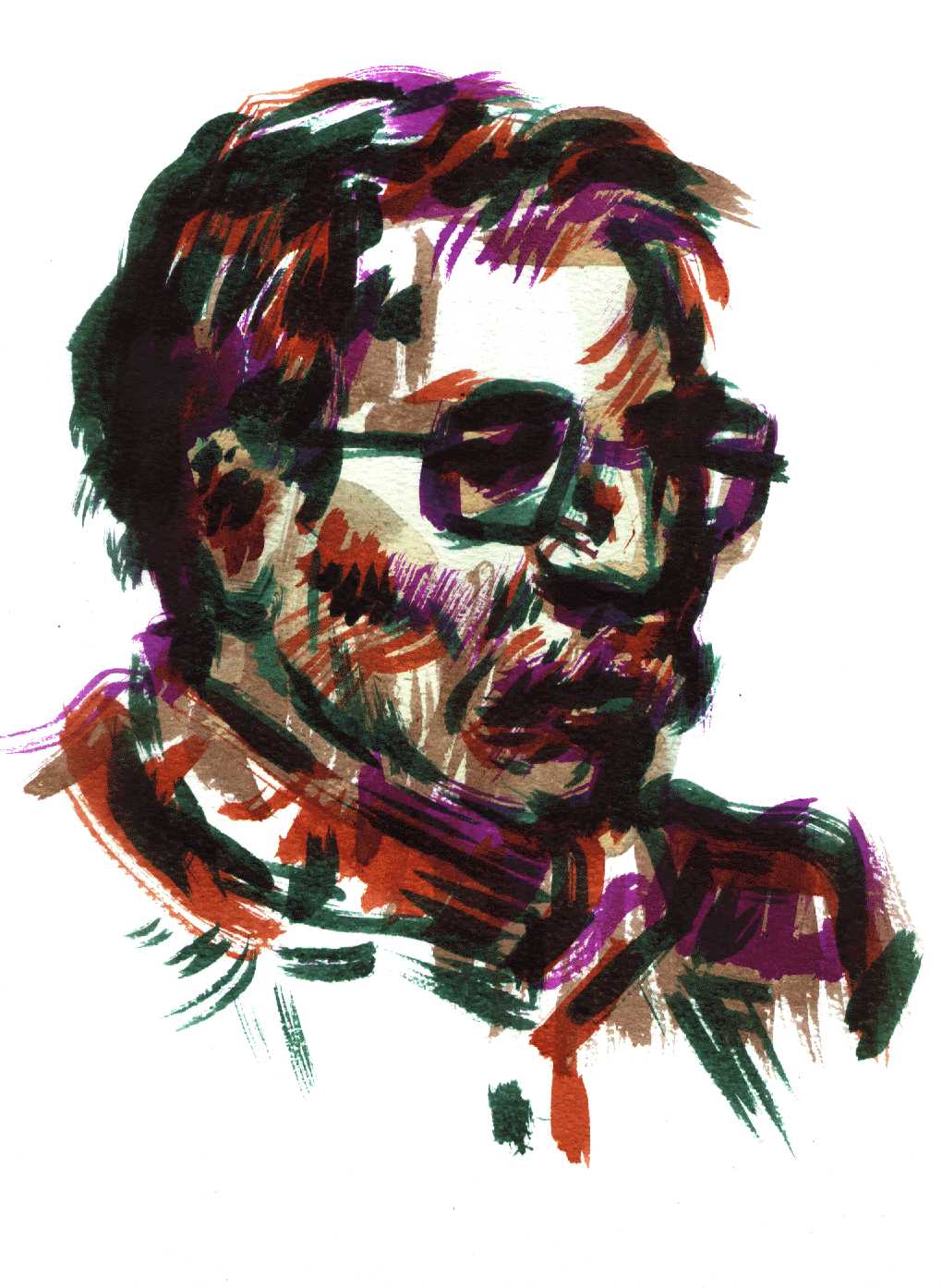
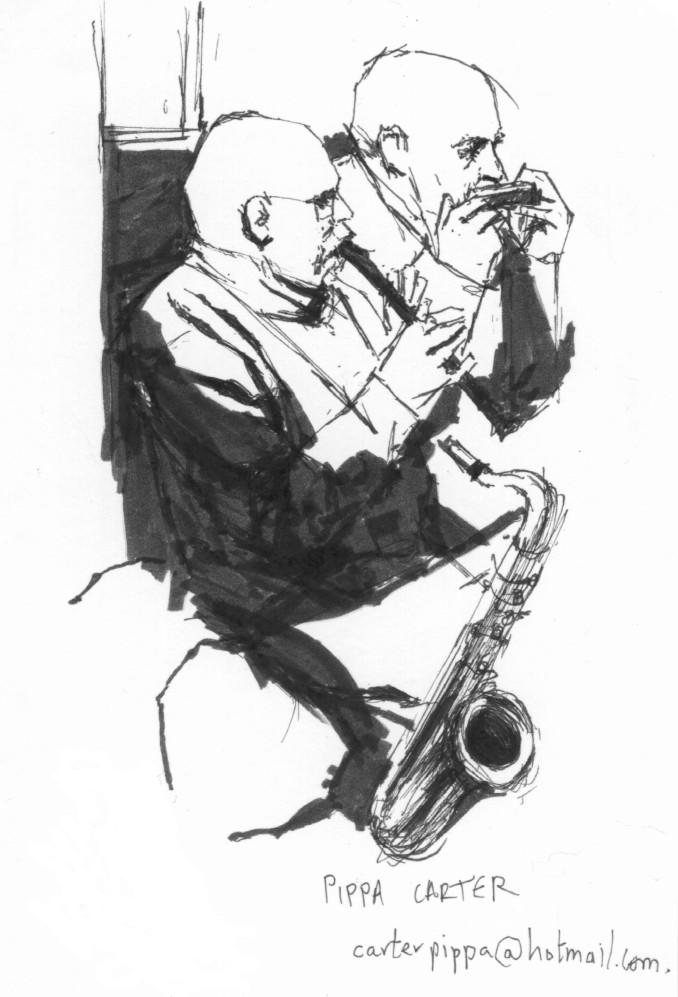
- Me and George Current
drawn in felt tip, Christmas 2009, by Pippa Carter.
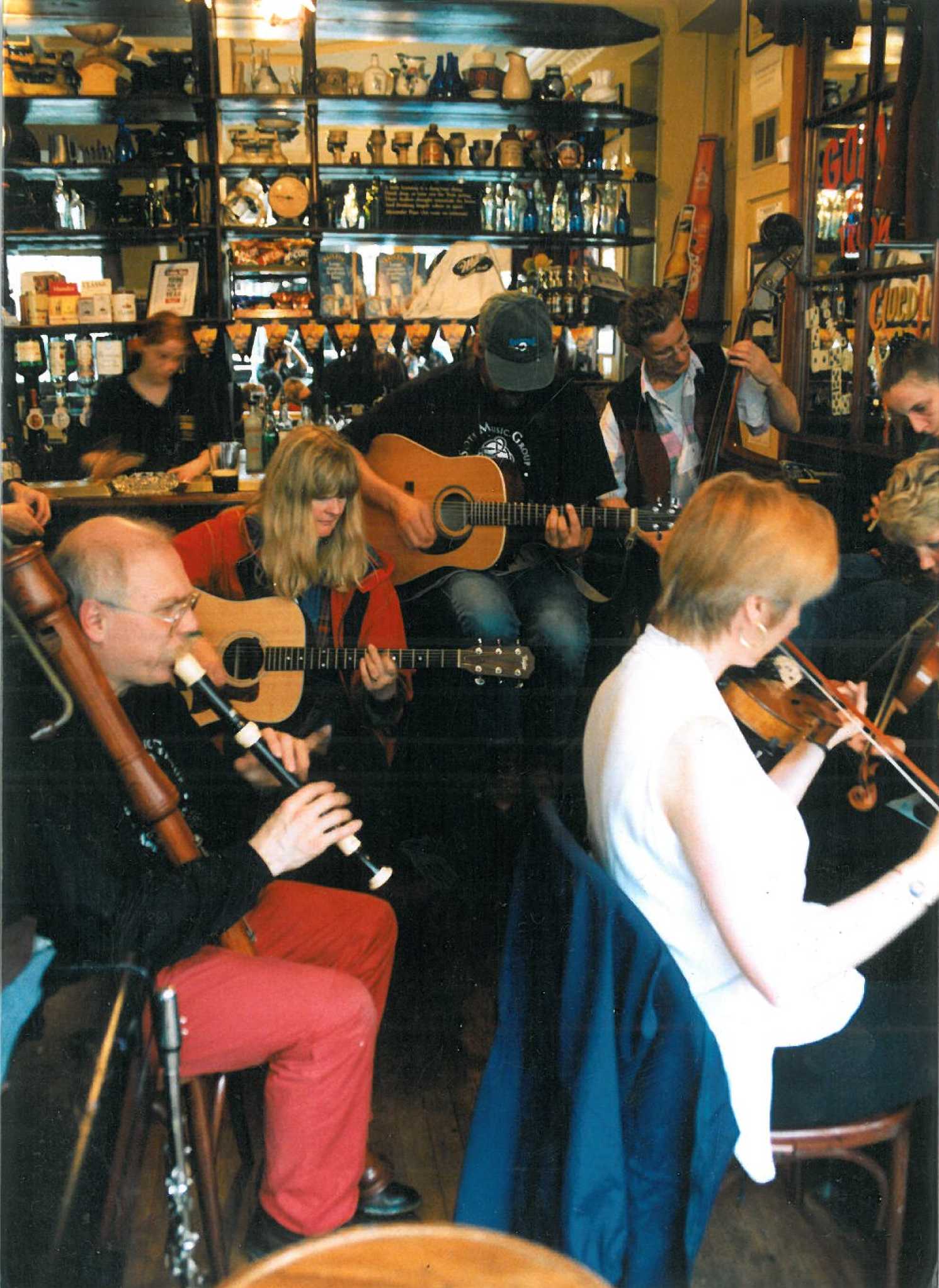
- Me (with alto and greatbass recorders
and G clarinet) at the Tron Bar in Edinburgh in the early 1990s,
when Cy Laurie was managing it as a music venue. Alan Grieve and
Sigga from Iceland on guitars, Freddy Thomson on bass.
- Travels with an electronic bagpipe.
- Travel stuff:
- A visit to two music and dance camps
in Hungarian communities in Romania, summer 2008. Includes links
to many external sites; it's meant to provide an introduction to
the music and dance of the Csángó Hungarians of
Moldavia and Transylvania.
- Photos from Split, Croatia,
spring 2003.
- Photos from Sarajevo, Bosnia,
spring 2003.
- Photos from Mostar, Bosnia,
spring 2003.
- Photos from Omis, Croatia,
spring 2003.
- Photos from Kosljun Franciscan
Monastery, Croatia, spring 2003.
- Random oddities:
- Freeware TrueType logic fonts for MacOS
- Resources on food intolerance and healthy eating
- My cat pages
- My CV, including links to my papers. There's
a very large gap at the end of it: the CD-ROM work, Embro, Embro
in particular, is why.
I play Scottish traditional music on recorders, whistles and clarinets,
and sing (baritone). I've been in a few groups over the years, including
a long musical partnership with Harriet Grindley (clarsach).
Another of my musical multiple personalities used to play the washboard
with the band for Edinburgh's New England contradance group. The group
has now folded, but if you come across someone around Edinburgh or at a
Scottish festival playing a washboard for traditional music in a unique
style based on military and dance-band snare drumming, that's me.
This link kills spam
Email: j a c k (at) c a m p i n (d0t) m e (d0t) u k
Mobile: 07800 739 557